The lowest business loan rate is not necessarily the best finance option. Choosing a lender means looking at what you need the money for, whether your business fits the lender's criteria, how the loan is structured and what the finance will actually cost.
At loan-o, we narrow the decision down to four practical checks:
Purpose → Fit → Structure → Cost
It sounds simple, but these four questions can turn a very large lender market into a much more relevant shortlist for the business in front of us.
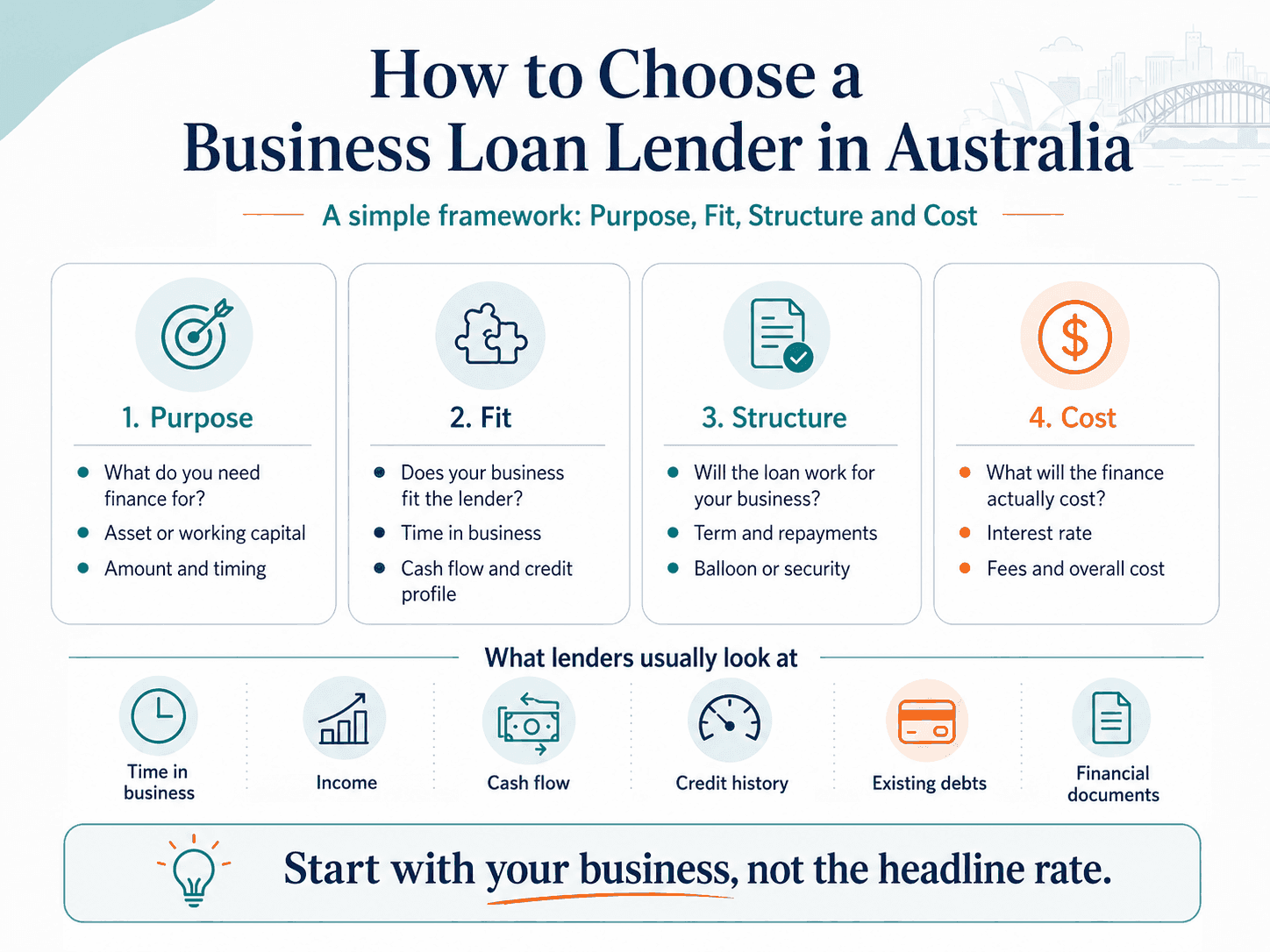
How do you choose a business loan lender?
When choosing a lender for a business loan, compare more than the interest rate they advertise.
A useful lender comparison should look at:
| What to compare | Why it matters |
|---|---|
| Purpose | Different finance products are designed for different business needs |
| Lender fit | Lenders have different credit criteria and risk appetites |
| Structure | Loan terms, repayments and security can affect how the finance works for your business |
| Cost | Interest, fees and other charges can all contribute to the overall cost |
Australian Government guidance similarly recommends understanding your business finances, deciding what type of funding you need and comparing lenders and costs before applying for business finance.
Australian Government - Apply for a business loan
Here is how we put that into practice.
1. What do you actually need the finance for?
Before choosing a lender, it is important to understand the job the money needs to do.
Imagine one business wants $90,000 to buy an excavator.
Another business needs the same $90,000 for working capital.
Same amount.
Very different requirement.
The right product, lender and repayment structure may also be very different.
Before we start comparing lenders, we want to understand things like:
- What are you financing?
- How much do you need?
- When do you need the money?
- Is the requirement short-term or long-term?
- Are you buying a vehicle, equipment or another business asset?
- Is the money for working capital, growth or refinancing?
- Will the asset being financed generate income for the business?
- How long do you realistically expect to take to repay the finance?
Why does the purpose matter?
A business term loan, line of credit, equipment finance facility and vehicle finance agreement are designed to solve different problems.
If we start with the lender before understanding the purpose, we may end up comparing products that were never a good fit in the first place.
2. What do business lenders look at?
Business lenders assess an application against their own lending criteria and risk appetite. Those criteria vary between lenders and between products.
Depending on the finance being considered, a lender may look at factors such as:
- How long the business has been trading
- Business income and cash flow
- Existing debts and financial commitments
- Business and director credit history
- Business structure
- Purpose of the loan
- Type, age and value of the asset
- Deposit or equity
- Available security
- Financial statements
- Bank statements
- Financial forecasts
- Other documents required for the application
Australian Government guidance recommends having a clear picture of your income, expenses, debts and cash flow before applying for finance. Documentation requirements can also vary depending on the lender and loan type.
Australian Government - Apply for a business loan
Why does lender fit matter?
Imagine two businesses trying to finance the same $70,000 vehicle.
Business A
- Has been trading for six years
- Has consistent revenue
- Has an established financial history
- Has strong cash flow
Business B
- Has been trading for 14 months
- Has strong recent turnover
- Has less historical financial information
- Has a different set of documents available
Same vehicle.
Same loan amount.
Potentially a completely different lender shortlist.
One lender may be comfortable with the first profile but not the second. Another may have criteria that better suit a newer business.
That is why asking only:
“Who has the lowest business loan rate?”
can lead you in the wrong direction.
A more useful question is:
“Which lenders are a realistic fit for this particular application?”
3. How will the business loan actually work?
A loan can be approved and still not be well suited to the way your business operates.
Once we understand lender fit, the next question is what the finance will look like after settlement.
We consider things such as:
- Loan term
- Repayment amount
- Repayment frequency
- Fixed or variable interest rate
- Secured or unsecured structure
- Balloon or residual payment
- Security requirements
- Personal guarantees
- Additional repayment options
- Early payout conditions
- Ongoing fees
These features can materially change both cash flow and overall cost.
Loan term
A shorter loan term can mean higher regular repayments, but fewer years carrying the debt.
A longer term can reduce the regular repayment, but it may increase the total amount paid over time.
Neither is automatically better.
The important question is what the business can realistically manage while still maintaining healthy cash flow.
Balloon or residual payment
Some vehicle and equipment finance structures may include a larger payment at the end of the term.
A balloon can reduce regular repayments, but that amount still needs to be dealt with later.
Before accepting this type of structure, make sure you understand:
- The balloon amount
- When it becomes payable
- How it affects the regular repayment
- How it affects the overall finance cost
- What options may be available at the end of the term
Repayments and business cash flow
The repayment schedule should also make sense for how money actually moves through the business.
A business with stable monthly revenue may have different needs from a seasonal business or a contractor who receives larger payments around project milestones.
Australian Government guidance recommends using cash flow information to understand what level of repayment your business can realistically afford.
Australian Government - Apply for a business loan
4. What will the business finance actually cost?
The interest rate matters, but it does not tell you the full cost of business finance.
Depending on the product, costs may include:
- Interest
- Establishment fees
- Documentation fees
- Account or ongoing fees
- Broker fees, where applicable
- Settlement costs
- Valuation costs
- Early payout fees
- Other charges under the finance agreement
Australian Government guidance recommends comparing set-up costs and ongoing fees alongside interest rates.
A lower rate may look attractive, but that does not automatically mean the finance will cost less overall.
That is why we look at the whole finance structure rather than one number in an advertisement.
Australian Government - Reduce your business loan costs
Is the lowest business loan rate always the best?
No. A lower interest rate does not automatically make one business loan better than another.
Imagine these two simplified options:
| Option A | Option B | |
|---|---|---|
| Interest rate | Lower | Slightly higher |
| Establishment costs | Higher | Lower |
| Early repayment flexibility | Limited | More flexible |
| Loan term | Longer | Shorter |
| Balloon payment | Yes | No |
Which one is better?
There is not enough information to answer that from the interest rate alone.
The right comparison depends on how the costs, repayments, flexibility and structure work with the needs of the business.
This is also why understanding the difference between an advertised rate and the broader cost of borrowing matters.
Understanding Comparison Rates →
How does loan-o compare business finance lenders?
We start with the business and narrow down the options from there, rather than starting with a lender name.
Our approach comes back to the same four checks.
Purpose
What does the business actually need the finance to achieve?
Fit
Which lenders and products are realistic for the application?
Structure
Which loan terms and repayment arrangements make sense for the way the business operates?
Cost
What are the relevant rates, fees and broader financial commitments?
Together, these questions help us answer something more useful than:
“Who offers the cheapest loan?”
What we really want to understand is:
“Which available finance options make sense when the borrower, purpose, structure and cost are considered together?”
That difference matters.
Should you compare bank and non-bank business lenders?
Yes, it can be worth considering both banks and non-bank lenders rather than assuming one category will always provide the better option.
Different lenders can have different:
- Credit criteria
- Finance products
- Documentation requirements
- Security requirements
- Loan amounts
- Repayment structures
- Rates and fees
Australian Government guidance recommends shopping around and considering different lenders rather than assuming your existing bank will automatically provide the most suitable finance.
Australian Government - Reduce your business loan costs
The better option depends on the individual application.
Should you use a business finance broker?
A business finance broker can help you understand your finance needs, identify lenders that may suit the application and compare available options.
But a large lender panel on its own does not make a recommendation useful.
You should still understand why a particular lender or product is being considered.
Useful questions to ask include:
- Which lenders can you consider for my application?
- Why does this lender suit my situation?
- What rate applies to my application?
- What fees will I pay?
- How is the broker paid?
- What will the repayments be?
- Are there any balloon or residual payments?
- What happens if I want to repay the finance early?
- Are there other suitable options worth considering?
Clear answers are more valuable than a long list of lender logos.
What should you compare before accepting a business loan?
Before accepting business finance, make sure you understand:
- What the finance is being used for
- The actual interest rate offered
- Whether the rate is fixed or variable
- Upfront and ongoing fees
- Regular repayment amount
- Repayment frequency
- Loan term
- Any balloon or residual payment
- Security and guarantee requirements
- Early repayment or exit conditions
- The estimated overall cost
- Why the lender and product suit your situation
If something is unclear, ask before signing.
The key takeaway
Choosing a business loan lender is not about finding the smallest number in an advertisement.
Start with what the business actually needs the money to do.
Then ask:
Purpose. Fit. Structure. Cost.
Does the finance solve the right problem?
Does the business fit the lender?
Does the structure work with the way the business operates?
And when everything is considered together, what will the finance actually cost?
Those questions provide a much stronger basis for choosing business finance than the headline rate alone.
Found this helpful?
If loan-o has helped you with your finance, a quick Google review helps other Australians find a broker they can trust.
Finance is subject to lender approval, lending criteria, terms, conditions, fees and charges. loan-o is a finance broker, not a lender. The information in this article is general and does not take into account your personal or business needs.
Last reviewed: 13 August 2026. This article was prepared using guidance available from the Australian Government (business.gov.au). This content provides general information only. It should not be treated as personal financial, tax, legal or credit advice.
Frequently asked questions.
Got a question about your own situation? Ask a specialist →
There is no single business loan lender that is best for every Australian business. The right lender depends on the purpose of the finance, the business profile, financial position, available security, loan amount and preferred structure.
Depending on the lender and product, they may assess business income, cash flow, debts, trading history, credit history, available security, loan purpose and supporting financial documents.
Not automatically. The interest rate should be considered together with fees, repayments, loan term, security requirements, balloon payments, flexibility and other conditions.
Neither is automatically better. Banks and non-bank lenders have different products, credit criteria, rates, fees and documentation requirements. The right fit depends on the individual application.
There is no universal number. The goal is to compare enough relevant options to understand whether the available rate, fees, structure and lender criteria make sense for your business.
Yes. A business finance broker can help assess your finance requirement, identify lenders that may suit the application and explain differences between available options. You should still understand which lenders they can access, how they are paid and why a particular option is being recommended.
Not sure what fits your business? Ask a loan-o specialist.
No obligation, no jargon - just a straight answer about what your business actually qualifies for.
Ask a finance specialist →